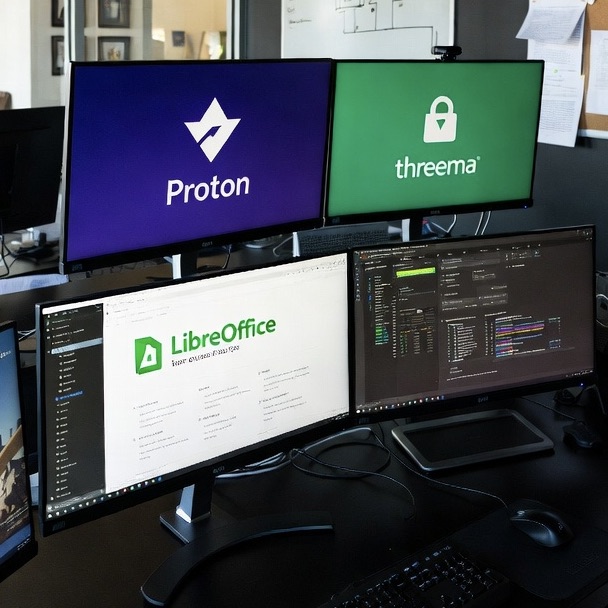
Privacy-First Alternatives for Private and Professional Use
In today's digital landscape, where data is a prime target for adversaries, surveillance, breaches, and exploitation, protecting sensitive information is non-negotiable—especially for professionals in high-stakes fields like defense, security, intelligence, and risk management. Big Tech platforms often prioritize monetization through data collection over true user privacy, creating vulnerabilities that can compromise operational security (OPSEC), personal safety, and client confidentiality.
At NDG, we recommend a deliberate shift away from dominant platforms like Google (Gmail, Drive, Docs), Microsoft Office, and WhatsApp toward privacy-first alternatives. These are just some of the strong options available—there are many other excellent tools and services out there depending on your specific threat model, workflow, and requirements—but we are providing our readers with a focused preview of solutions we frequently recommend and trust for high-risk environments.
Why Move Away from Google Products (Gmail, Drive, Docs) to Proton
Google's ecosystem excels in convenience and integration, but its business model relies on extensive data collection. Gmail scans emails for advertising and profiling purposes (even if not always for direct ads in paid Workspace plans), while Drive and Docs store files in ways that allow Google access. Under U.S. jurisdiction, data can be subject to broad government requests via mechanisms like those in the Five Eyes alliance.
Proton, headquartered in Switzerland and protected by some of the world's strongest privacy laws, takes a fundamentally different approach:
End-to-end encryption and zero-access architecture ensure that only you (and intended recipients) can read emails, view files, or edit documents—not Proton, not third parties, and not governments without your keys.
No ads, no tracking, no data selling or profiling.
Open-source apps with independent security audits for transparency.
A full suite including Proton Mail (secure email), Proton Drive (encrypted cloud storage), Proton Docs (collaborative editing), Proton Calendar, and more—all with seamless encryption.
Features like Easy Switch make migrating from Gmail straightforward, importing emails, contacts, and forwarding automatically.
Adding to Proton's privacy-focused ecosystem is Lumo, their confidential AI assistant launched as a direct, privacy-first alternative to tools like ChatGPT. Unlike mainstream AI services that log conversations, use them for training models, or share data with third parties, Lumo keeps every chat confidential:
Zero-access encryption means chats are protected, with no server-side logs and no access even by Proton.
Conversations are never recorded, tracked, profiled, or used for AI training.
You get powerful assistance for drafting, research, analysis, and more—without compromising your data or feeding it into Big Tech's surveillance machine.
This shift reduces risks from mass surveillance, data breaches, or corporate exploitation, providing a more defensible digital footprint without sacrificing core functionality.
Why Switch from Microsoft Office to LibreOffice
Microsoft 365 offers powerful cloud collaboration, but it collects required and optional telemetry data—including hardware/software details, IP addresses, and usage patterns—to "improve services." Files stored in OneDrive are accessible to Microsoft, and the subscription model ties you to ongoing data flows.
LibreOffice, a free, open-source office suite (Writer for documents, Calc for spreadsheets, Impress for presentations), stands out for privacy-conscious users:
Completely local-first: Documents save on your device by default, with no mandatory cloud sync or telemetry.
No user profiling, no data collection without explicit consent, and no creation of usage profiles.
Supports strong local encryption (e.g., via passwords or GNU Privacy Guard keys) and recent updates enhance privacy by stripping sensitive metadata (author names, timestamps, printer info) from files.
High compatibility with Microsoft formats for sharing, plus it runs offline on older hardware without subscriptions.
For teams or individuals handling sensitive reports, assessments, or client data, LibreOffice ensures full ownership and control—free from vendor lock-in or hidden data sharing.
Why Move from WhatsApp to Threema
WhatsApp (Meta-owned) uses end-to-end encryption for messages, but it collects significant metadata (contacts, IP addresses, timestamps, usage patterns) and integrates into Meta's broader ecosystem for profiling and advertising. Business chats may lack full encryption, and phone number requirements tie identities to real-world data.
Threema delivers superior privacy for secure communication:
End-to-end encryption for all messages, voice/video calls, and files using strong, open-source-based cryptography with Perfect Forward Secrecy.
True anonymity: No phone number or email required—just a random Threema ID.
Minimal metadata: Contact lists stay on your device, messages delete from servers after delivery, and no central storage of personal details.
Swiss-based with servers in Switzerland, GDPR-compliant, open-source clients (with regular audits), and no ads, tracking, or Big Tech ties.
Features like structured groups, polls, and file sharing—all encrypted.
Threema minimizes digital traces and surveillance risks, making it ideal for confidential discussions, operational coordination, or client interactions where metadata could reveal patterns or associations.
Making the Transition: Practical Steps and Considerations
Switching requires upfront effort but pays dividends in reduced exposure:
Use Proton's Easy Switch for Gmail migration, and explore Lumo at lumo.proton.me for private AI needs.
Export Microsoft files and import to LibreOffice (test compatibility for complex docs).
Share Threema IDs instead of phone numbers; encourage contacts to join for full benefits.
Start with high-priority accounts (e.g., professional email and AI tasks) before full migration.
Combine tools: Proton (including Lumo) for cloud and AI, LibreOffice for local editing, Threema for comms.
While no solution is perfect—Proton (and Lumo) may feel less polished in some features than Google or ChatGPT equivalents, and Threema has a smaller user base—the privacy gains are substantial for those who value OPSEC.
At Nous Defions Group℠ LLC, we prioritize tools that align with mission security and personal sovereignty. These recommendations represent a solid starting point, but your exact stack should be tailored to your operational needs and risk profile. If you're ready to assess your digital risk profile, explore additional options, or need guidance on implementation, contact us at (910) 838-9099 or visit nousdefionsgrp.com. Empower your future—defy the limits of unchecked data exposure.


